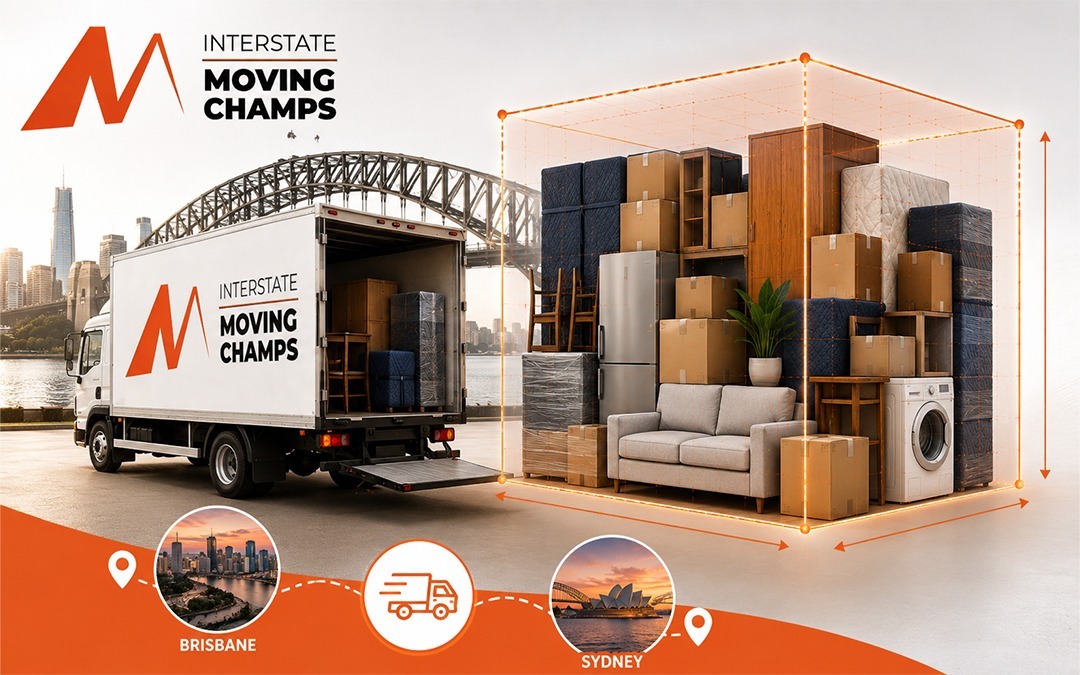
When people first look into Backloading Brisbane to Sydney, one phrase keeps popping up and confusing everyone: the cubic meter. Movers talk about “per cubic metre” prices, “shared load moving”, “space on the truck” – and it’s hard to know what you’re actually paying for.
This guide unpacks what a cubic metre really means, how it affects your quote with removalists Brisbane to Sydney, and how to estimate your own space so you don’t overpay or under‑book.
What is a cubic meter in moving terms?
A cubic meter (m³) is just a way of measuring how much space your stuff takes up in the truck. Think of it as a 1m x 1m x 1m box.
- 1 metre long
- 1 metre wide
- 1 metre high
That “invisible box” is 1 cubic meter. When you book Backloading Brisbane to Sydney, you’re basically renting a certain number of those boxes on a shared truck.
Movers don’t just care about weight. On backloads, space is the big factor. Your things are stacked, packed and tied in with other people’s loads – so knowing how many cubic metres you need tells the company:
- How much room to reserve for you
- How many other jobs can they fit on the same run
- How to price your share fairly
Why backloading use cubic meter pricing
With Backloading Brisbane to Sydney, you’re not paying for the whole truck. You’re paying for the slice of space you actually use. That’s why:
- It’s cheaper than hiring a full dedicated truck
- It’s ideal for smaller or medium-sized moves
- It works well for flexible dates, because they fill the truck with multiple jobs
Most interstate removalists use a cubic metre rate for backloads. For example (generic, just to illustrate):
- A small backloading job might be priced at $120–$150 per cubic metre
- If you use 6 m³, you might be looking at something like $720–$900.
- If you use 10 m³, it might be around $1,200–$1,500.
Actual numbers will vary by company, date, and demand – but that’s the logic: space x price per cubic metre.
How much is 1 cubic meter in real life?
It’s all well and good to talk about cubic metres, but what does that look like in your lounge? Here are some rough, human‑friendly comparisons.
- A standard moving box (like 60cm x 40cm x 40cm) is about 0.1 m³.
- A front‑loader washing machine is usually close to 0.5–0.7 m³
- A 2‑seater sofa might be roughly 1.5–2 m³ once wrapped
- A queen mattress + bed frame, combined and stacked, might take around 1.5–2 m³.
These are ballpark figures, not exact measurements. But they help you visualise it.
Example: a small 1‑bed flat as backloading cargo.
Let’s say you’re moving a small 1‑bedroom from Brisbane to Sydney and using Backloading Brisbane to Sydney rather than a full truck. You might have:
- 1 x queen bed + mattress → ~2 m³
- 1 x small sofa → ~1.5 m³
- 1 x TV + TV unit → ~1 m³
- 1 x washing machine → ~0.7 m³
- 1 x fridge → ~1 m³
- 10–15 boxes → ~1.5–2 m³
- Total rough estimate: 7.7–8.2 m³
If your chosen removalists Brisbane to Sydney charge, say, $130 per m³ on a shared load, then:
- 8 m³ x $130 = $1,040 (just as a generic example)
Again, your real quote will depend on the company, season, and exact load, but this shows how cubic metre pricing works only.
Shared load moving: how your stuff fits in the truck
With shared load moving, the truck is like a giant Tetris game:
- Your items are stacked into a measured space
- Another customer’s items might be behind or beside yours
- The mover plans the order based on pick‑up and drop‑off points
This is why good packing and accurate cubic metre estimates matter:
- If you underestimate your space, they might not have room for everything
- If you overestimate too much, you might reserve more space than you really need and pay extra
Most interstate removalists will ask you for a list of items so they can estimate the cubic metres for you. Some will have online calculators or example charts (“typical 1‑bed unit ≈ X m³”, “2‑bed house ≈ Y m³”).
How to roughly calculate your own cubic meter usage
A simple DIY way to estimate:
- Make a list of your big items (beds, couches, white goods, tables).
- Estimate each piece using rough guides, e.g.:
- Single bed: ~1–1.5 m³
- Queen bed: ~1.5–2 m³
- 3‑seater sofa: ~2–3 m³
- Fridge: ~1–1.2 m³
- Count your boxes
Every 10 mid‑size boxes ≈ is 1 m³
- Add a small buffer
Add 10–15% on top to be safe (padding, awkward shapes, extra bits you forgot)
Then compare your estimate with what the removalists Brisbane to Sydney suggest. If you’re wildly different, ask them to explain their reasoning. A good company will happily walk you through it.
Why cubic meters matter more than “number of items”
It can be tempting to say, “I’ve just got a bed, a couch and some boxes,” and hope for a quick price. But what really matters on Backloading Brisbane to Sydney is:
- How big are those items
- How they stack
- Whether they’re awkward shapes
For example:
- A huge, deep corner sofa might take up more cubic metres than a standard 3‑seater and an armchair combined.
- A low, wide coffee table might use more floor space than you realise.
This is why the cubic meter is a fairer way to price shared loads than just counting pieces. Two people can say “I’ve got a couch and a bed”, but one might fill twice the space of the other.
Prices per cubic metre: what affects the rate?
Even though many interstate removalists use cubic metre pricing, the per‑m³ rate itself can change based on:
- Time of year (peak moving seasons are busier)
- How flexible you are with dates (backloads often run on set days)
- Access issues (stairs, long carries, difficult parking).
- Extra services (packing, dismantling, wrapping).
So while a generic example might be $120–$150 per cubic metre for a Backloading Brisbane to Sydney run, your quote might be lower or higher if:
- You’ve only got a very small load (minimum charges apply)
- You need extra labour at each end
- You’re combining backloading with temporary storage
The key is: don’t just ask “what’s your price per cubic metre?” – also ask what that includes.
When backloading makes the most sense
Backloading is usually a great fit if:
- You don’t need an exact hour‑by‑hour delivery time
- You’re moving a small or medium load
- You’re happy to share truck space to save money
- You want professional handling without paying for a whole truck
If you have a full 3–4 bedroom home and need very tight timing, a dedicated truck might still be better. But for many people with lighter loads, Backloading Brisbane to Sydney is one of the most cost‑effective ways to use professional removalists Brisbane to Sydney.
Quick recap in plain language
A cubic metre is a 1m x 1m x 1m chunk of space.
- In backloading, you pay for how many of those chunks your stuff uses.
- Typical loads are a mix of big items + boxes – the mover estimates how they stack.
- Prices are often “$X per cubic metre”, so knowing your space helps you understand your quote.
- Shared load moving means your things travel with others’, which is why accurate volumes matter.
If you like, you can send a rough list of items (bed size, number of couches, appliances, and boxes). A volume estimate can be sketched out in cubic metres to show how that might translate into a backloading quote.
